
4.1 Loose smut
The causative agent of the disease is the fungus Ustilago tritici (Pers.) Yensen.
Indicators of the illness, along with the pathogen's morphological and biological characteristics: All organs of the ear, except for the rachis, are completely transformed into a black, sooty mass (Figure 58) consisting of the teliospores of the fungus (Figure 59). They have a round or oval form, sometimes angular, light olive or brown in colour. One side is slightly thickened, while the other is covered with a shell bearing small warty projections. Their size varies depending on the cultivation zone and often ranges from 7-9 × 5-7 micrometers.
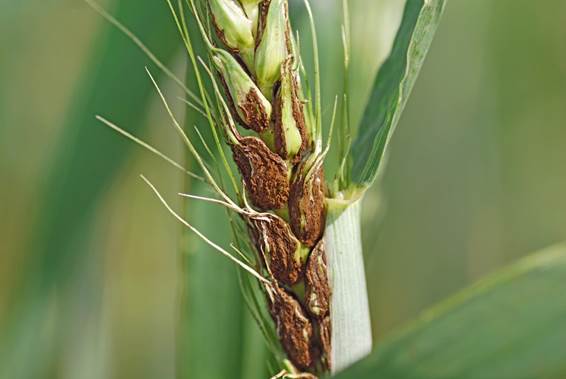
Figure 58 - Loose smut of wheat

Figure 59 - Teliospores of the fungus Ustilago tritici
During the wheat flowering phase, there is a considerable release of teliospores, which settle on the stigmas of the flowers and begin to germinate, forming the initial mycelium. This mycelium undergoes cell fusion, creating an infectious hypha that penetrates the ovary through the pollen tube. The pathogen's mycelium can be detected in various parts of the seed, including the seed coat, spikelet, embryo, and the developing root. Infected seeds, although harboring the loose smut mycelium, appear indistinguishable from healthy seeds externally. The pathogen remains inactive until the following planting season, at which point it becomes active again as the seeds germinate in the soil. As the mycelium spreads, it reaches the developing ear, where it expands, thickens, becomes slimy, and eventually disintegrates into chlamydospores, completely damaging the ear. In some cases, only the lower portion of the ear is affected, while the upper section still produces grain. This partial damage does not constitute a defensive mechanism by the plant and is not passed on to future generations (Shvartsman, 1960; Ishpaikina et al., 1972).
Spread and harmfulness. The extent of crop damage caused by loose smut is influenced by factors such as the timing and conditions of wheat flowering, the weather during this period, and the resistance of the specific wheat variety. The germination of fungal teliospores and subsequent infection of the plants only occur when there are liquid water droplets present or when air humidity levels range from 60-70%, with temperatures between 20 and 25 °C. The disease is most noticeable in the northern and northeastern regions of Kazakhstan, where rainfall during the wheat heading and flowering stages is common, and the average daily humidity often reaches 65-75%. Research has shown that the timing and duration of wheat flowering significantly impact the susceptibility of different varieties (Penchukova, 1974).