
5.1 Phytosanitary condition of spring wheat seeds
Spring wheat seeds serve as a favorable environment for the development of pathogenic microflora [40], which reduces seed viability and affects the growth and development of plants through the release of various mycotoxins [41, 42]. We analysed a number of indicators of the phytosanitary condition and sowing quality of spring wheat seeds and determined the phytosanitary condition of spring wheat seeds in the conditions of North-Eastern Kazakhstan. A total of 22 spring wheat varieties were analyzed. The sowing characteristics of seed varieties were determined, and variety differences that affect seed sowing quality were identified.
According to our research, the ‘Omskaya 38’ and ‘Triso’ varieties are dwarf varieties with coleoptile lengths of 4.2 and 4.1 cm, respectively. The long coleoptile varieties include ‘Oksamyt mironovskiy’, ‘Iren’, and ‘Kurier’. The remaining studied spring wheat varieties are classified as medium coleoptile varieties according to Y.S. Larionov's classification [43]. The ‘Omskaya 35’, ‘Omskaya 36’, ‘Boevchanka’, and ‘Uralosibirskaya’ varieties showed sprout lengths of over 15 cm (Table 2).
Table 2 - Average indicators of the sowing quality of spring wheat seeds
|
Variety |
Length, cm |
Germination rate, % |
||
|
root |
coleoptile |
sprout |
||
|
‘Pamyat' Aziyeva’ |
12,2 |
5,8 |
13,4 |
97 |
|
‘Likamero’ |
10,8 |
4,8 |
11,9 |
96 |
|
‘Stepnaya volna’ |
10,5 |
6 |
12,2 |
77 |
|
‘Omskaya 35’ |
14 |
5,3 |
17,1 |
96 |
|
‘Omskaya 36’ |
11,4 |
5,2 |
18 |
95 |
|
‘Omskaya 37’ |
13,2 |
5,5 |
14,7 |
91 |
|
‘Omskaya 38’ |
11 |
4,2 |
5,7 |
97 |
|
‘Boevchanka’ |
12 |
5,3 |
16,9 |
90 |
|
‘Triso’ |
6,3 |
4,1 |
8,2 |
91 |
|
‘Granni’ |
13,4 |
4,7 |
7,4 |
98 |
|
‘Uralosibirskaya’ |
12,3 |
5 |
18,7 |
87 |
|
‘Oksamyt mironovskiy’ |
8,5 |
6,5 |
11,9 |
93 |
|
‘Favorit’ |
9,5 |
6 |
14,3 |
89 |
|
‘Saratovskaya 74’ |
7,7 |
4,6 |
11,6 |
65 |
|
‘Stepnaya Volna’ |
12,6 |
5,6 |
13,3 |
88 |
|
‘Pobeda’ |
7,5 |
5 |
9,5 |
90 |
|
‘Severyanka’ |
9,5 |
5,2 |
11,1 |
80 |
|
‘Alabuga’ |
10,7 |
6 |
14,1 |
84 |
|
‘Iren'’ |
13,6 |
6,1 |
15,2 |
90 |
|
‘Kurier’ |
13,5 |
6,5 |
15,3 |
79 |
|
‘Kazakhstanskaya 15’ |
12,3 |
6 |
12,8 |
86 |
|
‘Pavlodarskaya yubileynaya’ |
12,9 |
5,3 |
15,8 |
96 |
All tested varieties had germination rates above 80%, except for the ‘Stepnaya volna’ (77%), ‘Saratovskaya’ 74 (65%), and ‘Kurier’ (79%) varieties. The maximum possible germination rate of 97-98% was shown by the ‘Pamiat Azieva’, ‘Omskaya 38’, and ‘Granni’ varieties.
Table 3 presents data on the ratio of healthy and infected seeds and the prevalence of phytopathogens in the tested spring wheat varieties.
Table 3 - Results of phytosanitary examination of spring wheat seeds from 2023 harvests, %
|
Variety |
Healthy seeds |
Seeds infected with pathogens: |
including: |
Bacteriosis |
|||
|
B. sorokiniana |
Alternaria spp. |
Fusarium spp. |
Penicillium spp. |
||||
|
‘Pamyat' Aziyeva’ |
59 |
41 |
4 |
38 |
2 |
3 |
2 |
|
‘Likamero’ |
64 |
36 |
5 |
12 |
7 |
5 |
3 |
|
‘Stepnaya volna’ |
60 |
40 |
4 |
37 |
2 |
6 |
41 |
|
‘Omskaya 35’ |
38 |
62 |
3 |
7 |
12 |
7 |
4 |
|
‘Omskaya 36’ |
28 |
72 |
0 |
4 |
0 |
8 |
16 |
|
‘Omskaya 37’ |
42 |
58 |
4 |
21 |
28 |
2 |
34 |
|
‘Omskaya 38’ |
49 |
51 |
10 |
44 |
13 |
0 |
4 |
|
‘Boevchanka’ |
76 |
24 |
17 |
52 |
2 |
2 |
28 |
|
‘Triso’ |
62 |
38 |
12 |
31 |
3 |
1 |
14 |
|
‘Granni’ |
37 |
63 |
0 |
37 |
20 |
4 |
22 |
|
‘Uralosibirskaya’ |
27 |
73 |
2 |
46 |
9 |
0 |
10 |
|
‘Oksamyt mironovskiy’ |
31 |
69 |
0 |
44 |
7 |
0 |
30 |
|
‘Favorit’ |
36 |
64 |
6 |
45 |
4 |
3 |
18 |
|
‘Saratovskaya 74’ |
51 |
49 |
1 |
61 |
2 |
2 |
10 |
|
‘Stepnaya Volna’ |
39 |
61 |
5 |
39 |
18 |
9 |
39 |
|
‘Pobeda’ |
30 |
70 |
6 |
55 |
7 |
3 |
29 |
|
‘Severyanka’ |
68 |
32 |
2 |
49 |
7 |
3 |
26 |
|
‘Alabuga’ |
76 |
24 |
5 |
39 |
2 |
2 |
35 |
|
‘Iren'’ |
67 |
33 |
3 |
45 |
5 |
1 |
41 |
|
‘Kurier’ |
69 |
31 |
9 |
39 |
5 |
6 |
33 |
|
‘Kazakhstanskaya 15’ |
24 |
76 |
4 |
25 |
49 |
2 |
48 |
|
‘Pavlodarskaya yubileynaya’ |
60 |
40 |
1 |
19 |
17 |
1 |
6 |
The main phytopathogens causing mold in the tested wheat seeds are represented by the genus Penicillium spp.
The composition and level of seed infection in spring wheat varieties are presented in Figure 25.
In addition, it was noted that in the presence of a fungal invasion causing root rot of seed material, signs of disease may not manifest at the seed germination stage. Therefore, not all spring wheat varieties with a high degree of phytopathogenic load showed signs of root rot, except for the ‘Uralosibirskaya’ and ‘Kazakhstanskaya 15’ varieties, which had the highest percentage of infected seeds and, consequently, more sprouts with signs of root rot.
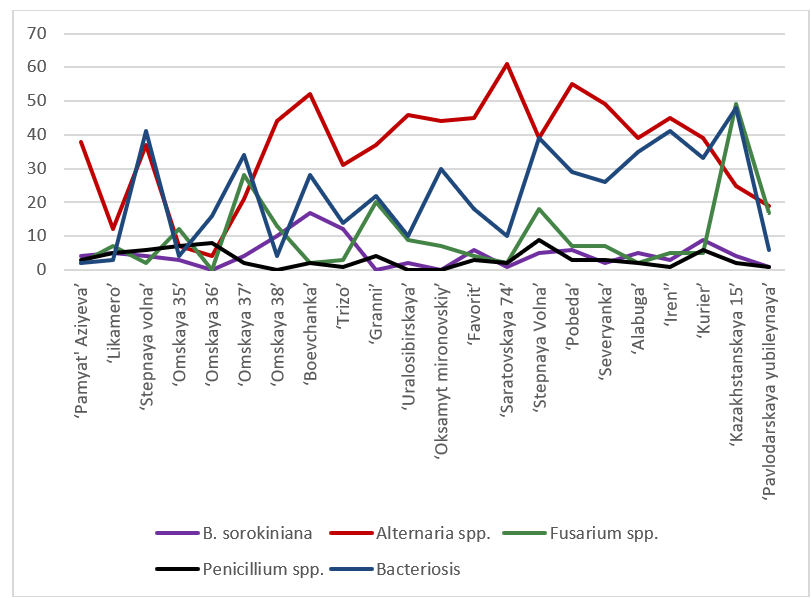
Figure 25 - Composition and level of seed infection in spring wheat varieties, %
According to the results of the phytopathological examination, all tested seeds were affected by pathogenic microflora. The minimum infection load among all studied varieties was observed in the ‘Boevchanka’ and ‘Alabuga’ varieties, with a percentage of healthy seeds at 76%. On average, 50.3% of infected cultivars were detected among all studied varieties (from 24% to 76%). The highest phytopathogenic load was observed in the seeds of ‘Omskaya 38’, ‘Omskaya 35’, ‘Granni’, ‘Omskaya 36’, ‘Uralosibirskaya’, and ‘Kazakhstanskaya 15’ varieties (from 51% to 76% infected seeds).
The research results showed that the most harmful pathogen causing root rot, Bipolaris sorokiniana - was not as active on the seeds of the 2023 harvest compared to the pathogenic microflora of the Alternaria spp. and Fusarium spp. genera.