
CHAPTER 12. STATE POLICY IN THE SPHERE OF RELIGION AND NATIONAL RELATIONS
12.1 Essence and main objectives of the state national and confessional policy.
Harmonization of interethnic relations at the present stage of society's development is one of the most significant areas of state policy, which affects many spheres of life: the spheres of economic, social, political and other relations. For quite a long time, attempts have been made to develop the most optimal model of interaction between representatives of different nationalities and cultures: the theory of «melting pot», «multiculturalism», etc. However, so far, no single and universal approach or mechanism has been identified that allows for maximum consideration of the national, cultural and religious diversity of representatives of different peoples.
National policy is a purposeful activity aimed at regulating relations between nations and ethnic groups, which is fixed in the relevant political documents and legal acts of the state. This is a system of measures implemented by the state aimed at taking into account, combining and implementing national interests, and resolving contradictions in the sphere of national relations.
In general, it should be taken into account that national policy is closely interrelated with social, regional, demographic and other areas of political activity. This is reflected in the fact that the national policy includes social, economic, linguistic, regional, migration, and demographic aspects. At the same time, in a multinational State, when implementing State policy in any sphere of public life, it is important to take into account national and ethnic aspects.
State national policy is a purposeful, scientifically based, legitimate, long-term, institutionalized in legal forms activity of state authorities and local self-government bodies aimed at implementing the provisions of the country's legislation and ensuring state integrity, equality, self-determination of peoples, their national and cultural development.
On the one hand, national policy is a state policy, since its principles, goals and objectives are formulated by the state. On the other hand, civil society institutions, non-governmental structures and formations (political parties, national and cultural autonomies, other public associations, local self-government bodies) can also take an active part in its implementation.
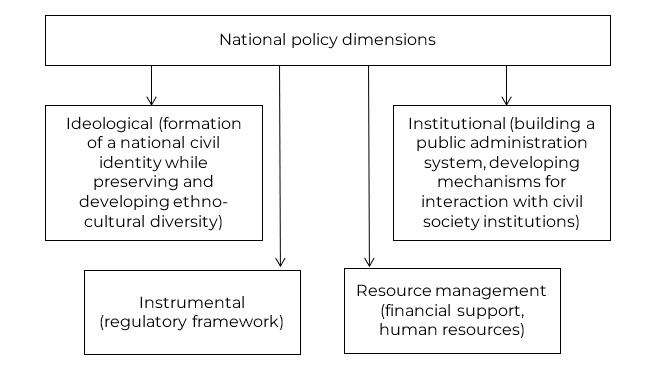
Due to the fact that interethnic interaction covers the entire sphere of public relations, it has a multidimensional orientation and has several dimensions, as shown in Figure 12.1.1.
Figure 12.1.1 – National policy dimensions.
The state's national policy is socially determined. One of its most important functions is positive or crisis management (in a broader sense than crisis management). It is important to prevent the negative consequences of governance in various spheres of public relations by taking into account the ethno-cultural and ethno-political factor.
The goal of the national policy is to satisfy the constitutional rights of citizens of the state, ethnic and religious, as well as to ensure socio-political stability. This is a complex task that can only be achieved through productive cooperation between the executive and legislative authorities, as well as civil society represented by national and religious public organizations. If any of the sides of this interaction «drops out» or its influence is reduced, then the system loses stability and rather unpleasant processes can occur. It is necessary to monitor the development of this situation very carefully. Such work is called monitoring of ethnopolitical stability and early conflict prevention.
An important task of a multinational state is to optimize interethnic relations, i.e. to find and implement the most favorable options for interaction between subjects of interethnic relations. The main thing in the content of national policy is the attitude to national interests, taking into account their commonality, divergence and collision. The commonality of the fundamental interests of individual subjects of interethnic relations and national interests on the scale of the state has objective grounds. The divergence of interests is related to objectively existing specific conditions and needs for the development of national and ethnic communities. When national and political interests are intertwined, their divergence can develop into a clash or conflict. In these circumstances, it is necessary to coordinate national interests as a prerequisite for their implementation, which is the meaning of national policy.
There are many approaches to the typology of national policies based on various criteria: goals, content, orientation, forms and methods of implementation, as well as on its consequences and results.
- depending on the goals, the national policy may have different strategic objectives. It can be focused on achieving national unity, strengthening internal cohesion, forming a common civic identity, promoting interethnic integration, rapprochement and gradual merging of ethnic groups. At the same time, the opposite goals are also possible: promoting ethnic isolation, striving for national autonomy or independence, protecting ethnic identity, preserving «ethnic purity», and countering cultural and political influence from other peoples.
- according to its content, the national policy can be classified on the basis of value and ideological grounds. It can have a humanistic character, which implies recognition and respect for the rights of all ethnic groups, or it can be based on the principles of internationalism, focused on the unity of peoples and cultural interpenetration. On the other hand, there are forms of inhumane politics – nationalistic, excluding other ethnic groups, or great-power chauvinistic, imposing the dominance of one nation over the rest;
- according to the orientation, such types of national policies can be distinguished as democratic (based on equal rights and participation of all ethnic groups in public life), peacemaking and creative (focused on strengthening harmony and developing interethnic cooperation), as well as totalitarian, militant-nationalist, destructive and reactionary, generating conflicts and increasing ethnic tensions;
- from the point of view of forms and methods of implementation, national policies can be based on the principles of non-violence, tolerance, dialogue, consideration of the interests of different ethnic groups, and respect for their cultural identity. At the same time, repressive forms of national politics are also known in history, based on suppression, discrimination, forced assimilation, deportations, and the use of the «divide and rule» principle to manipulate ethnic contradictions.
- according to the results of the national policy, one can observe a different picture of interethnic relations. The positive results are harmony, integration, cooperation, interethnic harmony and solidarity. In a negative scenario, politics can lead to ethnic tensions, alienation, conflicts, hostility, and even ethnic clashes.
National policies should be developed based on the country's characteristics and the level of its socio-economic development. A necessary condition for an effective and efficient national policy is its scientific character, which implies strict consideration of the laws and trends in the development of nations and national relations, scientific and expert study of issues related to the regulation of interethnic relations. Defining national policy goals, choosing ways, forms and methods to achieve them requires relying on a truly scientific analysis of the processes taking place, on qualified forecasts, and evaluating the available alternatives to the political course.
This should take into account the natural and climatic conditions, socio-historical features of the formation of an ethnic group, its statehood, demographic and migration processes, the ethnic composition of the population, the ratio of titular and non-titular nationalities, confessional characteristics, features of national psychology, the level of ethnic identity, national traditions, customs, relationships of the titular ethnic group with other socio-ethnic communities, etc. etc.
National policy functions:
- the function of goal setting, i.e. defining goals and objectives, developing programs of activities in accordance with the interests of all nations and ethnic groups of the country;
- organizational and regulatory function, i.e. the function of regulating the activities of social and political institutions, social groups, national organizations and movements, population groups, etc.;
- the function of integration, convergence of national and ethnic communities on the basis of common core interests and goals;
- the function of resolving interethnic contradictions, developing effective ways and methods of resolving interethnic conflicts;
- prognostic function, including the development of preventive measures to prevent possible complications and exacerbations of the ethno-political situation in the country or region;
- the function of educating people in the spirit of internationalism, respect for the national dignity of everyone, a high culture of interethnic communication, intransigence to the manifestation of nationalism and chauvinism.
A long-term program, the core of the national policy is its scientifically developed concept. The concept defines strategic goals and objectives of national policy, ways, forms and methods of solving national problems, scientific and practical support for the main directions of national policy.
The Constitution plays a decisive role in the national policy of the State. The Constitution of the Republic of Kazakhstan of 1995 states: «We, the People of Kazakhstan, united by a common historical destiny, creating statehood on the native Kazakh land...»[158]. Article 14 of the Constitution «No one may be subjected to any discrimination on the grounds of origin, social, official or property status, gender, race, nationality, language, attitude to religion, beliefs, place of residence or any other circumstances». Article 19 «Everyone has the right to use their native language and culture, to freely choose the language of communication, education, training and creativity». Important for the Russian-speaking population was the recognition that in state organizations and local self-government bodies, along with the Kazakh language, it was officially possible to use Russian[159].
On April 1, 1995, the Assembly of People of Kazakhstan (APK) was established − a consultative and advisory body under the President of the country, which appeared on the initiative of the First President of the Republic of Kazakhstan N. A. Nazarbayev. The main task of the APK is to implement the state national policy, ensure socio-political stability in the Republic of Kazakhstan and increase the effectiveness of interaction between state and civil institutions of society in the field of interethnic relations[160].
In 1997, as part of the Address of the President of Kazakhstan, the program for further development «Kazakhstan-2030» was announced. The Strategy identified seven long-term priorities, including national security, consolidation of Kazakhstan's society, well-being of citizens of the Republic of Kazakhstan, etc.[161].
In 2012, the program «Strategy-2050» was adopted, according to which the patriotic act «Mangilik El» is one of the vectors of further development of the country. As N. A. Nazarbayev noted, «Mangilik El» («Eternal Country») is a national idea. In his opinion, «in order to increase our achievements and develop comprehensively, the national idea must be viable and dynamic. The idea that consolidates the nation must meet the requirements of the time and take a place in the heart of every citizen[162]». Thus, the concept of «Mangilik el» was based on the process of constructing the Kazakh nation, which has a significant impact on the dynamics of the country's ethnic composition.
In 2017, in the article «Looking to the Future: Modernization of public consciousness», N. A. Nazarbayev outlined the main principles of implementing the Ruhani Zhangyru program. He noted that an important condition for modernization is the preservation of a unique national and cultural code that systematically connects «the horizons of the past, present and future». Modernization implies the preservation of the national culture, but eliminates elements that do not contribute to the «development of the nation»[163].
The current President of Kazakhstan, K. K. Tokayev, also continues the policy of national harmony and unity. In his message of September 1, 2022, he points out that «We will strengthen national harmony, partnership between government and society, following the concept of a 'listening state'... The unity of the people has always been our most important value, which is becoming even more important today… We will become a strong and successful nation when each of us fully strengthens unity and firmly follows the principles of justice»[164]».
Thus, if in the first years after independence, the leadership of Kazakhstan directed its efforts to stabilize the country's economy, at the present stage, the formation of patriotism and citizenship in Kazakhstan's society through the transformation of public consciousness and political modernization is becoming increasingly important.
[158] Constitution of the Republic of Kazakhstan https://adilet.zan.kz/rus/docs/K950001000_. Date of access 16.04.2025
[159] Andreev A. A. National Policy of the Republic of Kazakhstan during the Formation Period of Russian-Kazakh Relations 1990-1995 // Vestnik SPbU. – St. Petersburg, 2009. – Issue 2. – P. 194.
[160] https://assembly.kz/ru/ank/obshchaya-informatsiya/deyatelnost/. Date of access 16.04.2025
[161] Nazarbayev N.A. Strategy of Independence. – Almaty : Atamura, 2003. – P. 27.
[162] Preserving Identity and Unity / Website "Kazinform: International Information Agency." – Access mode: http://www.inform.kz/ru/sohranyayaidentichnost-i-edinstvo_a2797619. Date of access 16.04.2025
[163] Article by the Head of State "A Look into the Future: Modernization of Public Consciousness." April 12, 2017 / Official website of the President of the Republic of Kazakhstan. – Access mode:https://www.akorda.kz/ru/events/ akorda_news/press_conferences/statya-glavygosudarstva-vzglyad-v-budushchee-modernizatciyaobshchestvennogo-soznaniya. Date of access 16.04.2025
[164] https://www.akorda.kz/ru/poslanie-glavy-gosudarstva-kasym-zhomarta-tokaeva-narodu-kazahstana-181130. Date of access 16.04.2025