
CHAPTER 7. FUNDAMENTALS OF STATE REGIONAL POLICY
7.4 Regional policy implementation tools and mechanisms.
Since the beginning of the twentieth century, profound socio-economic transformations have affected various countries of the world. To a large extent, they have increased the importance of the problems of improving regional governance. In the context of globalization, regional policy is the most effective tool for socio-economic modernization of states. In recent years, the theory and methodology of regional governance has been significantly enriched by optimizing the systems of regional and municipal governance in various countries. These processes are taking place not only within countries, but also outside them, strengthening interregional ties and international cooperation in general.
Regional policy tools include: regional forecasting, regional programming, and indicative planning. Their relationship is shown in Diagram 7.4.1.
Scheme 7.4.1 – Interrelation of regional policy instruments and key areas of sustainable development of the region.
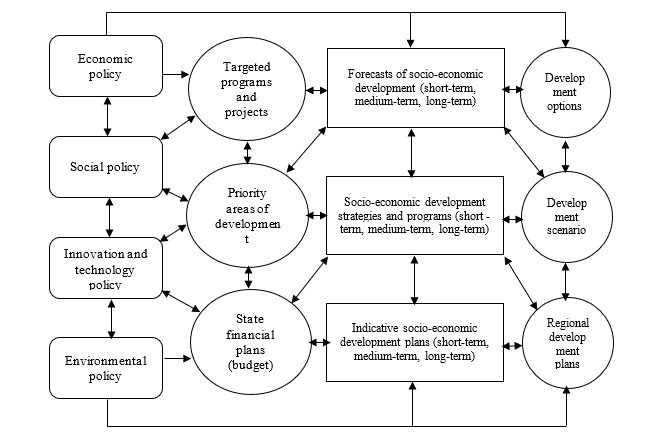
Regional programs may include various areas, including:
- social and economic programs aimed at ensuring a balanced development of the regions, equalizing the standard of living and socio-economic conditions, improving the availability and quality of social services, as well as reducing inter-regional disparities;
- economic programs that cover the rational allocation of production capacities, attracting investment, involving new resources in the economic turnover, stimulating entrepreneurship, as well as developing interregional cooperation and integration;
- resource and environmental programs that provide for sustainable management of natural resources, introduction of environmentally friendly technologies, reduction of the negative impact of industry on the environment, development of a nature protection system, as well as creation of favorable conditions for recreation and tourism;
- infrastructure programs aimed at developing transport, energy, digital and municipal infrastructure, ensuring equal access to modern communication and technological opportunities;
- cultural and educational programs that contribute to the preservation and development of cultural heritage, support of national traditions, development of the education and science system, as well as increase the level of human resources in the regions.
These programs are developed taking into account the specifics of each region and are aimed at creating conditions for its sustainable and balanced development.
Types of forecasts can be: social (demographic, interethnic, medical and household, cultural and spiritual, etc.), technical and economic (technological, industrial and economic, infrastructural, conjunctural, etc.), geographical (climatic, natural resource and environmental)[82].
The forecast is generally a system of scientifically based ideas (judgments) about possible scenarios and trends in the development of the economy, including the volume of production of the country's gross domestic product (GDP) in the future, as well as about alternative development paths. The process of developing a forecast is called forecasting and involves analyzing current trends, modeling possible future options, and evaluating factors that affect economic development. It is important to note that forecasting is not the same as foresight. Unlike foresight, which can be based on intuition or subjective assessments, forecasting is based on systems analysis, statistical methods, mathematical modeling, and expert assessments.
Forecasting is a necessary element of the system of state and corporate regulation of the market economy, it is inextricably linked with other elements-strategic indicative planning and programming[83].
Forecasts are classified according to various time horizons, including:
- operational forecasts cover a period of up to 1 year and are focused on short-term fluctuations and trends;
- short-term forecasts cover the period from 1 to 3 years and allow us to assess the near-term development prospects in conditions of relative predictability of macroeconomic and social factors;
- long-term forecasts are designed for a period of 4 to 10 years and take into account structural changes in the economy, technological shifts and institutional reforms;
- long-term forecasts cover the period from 10 to 20 years, are focused on strategic planning and take into account global trends, demographic changes and technological innovations;
- long-term forecasts cover a period of more than 20 years and are aimed at identifying megatrends, modeling long-term prospects for the development of society, the economy and the environment.
Forecasts are developed in various areas, including economic, scientific and technical, social, demographic, environmental, sectoral, regional and others. Each type of forecast is based on specific analysis methods and takes into account the specifics of the forecast area.
Regulation of regional development should be based on clearly defined goals and objectives that follow from the forecast of socio-economic development of the region. It should cover a wide range of areas, including:
- developing an effective economic policy, including the development of sound privatization strategies, supporting entrepreneurship and creating favorable conditions for small and medium-sized businesses in various territories of the region;
- rational use of natural resources, i.e. introduction of lean environmental management technologies, environmentally safe development of resources, development of a «green» economy;
- increasing the export potential, which includes expanding the volume and geography of exports, increasing the competitiveness of regional goods and services on international markets;
- developing a competitive environment, i.e. implementing antitrust policies, supporting healthy competition mechanisms, and reducing barriers to new market entrants;
- modernization of industry and agriculture, development and expansion of production of competitive products, introduction of innovative technologies and increase in productivity;
- attracting investment, i.e. creating a favorable investment climate, stimulating the inflow of foreign capital and advanced technologies to priority sectors of the region's economy;
- increase in foreign exchange earnings, including increasing the volume of foreign economic activity, developing export-oriented industries and improving mechanisms for attracting financial resources.
A regional development strategy – is a general direction for achieving goals, and even in the absence of specifics, it is still more useful to have a development direction than not to have them. An insufficiently clear but well-founded general direction can be implemented in tactical actions and programs that promote the development of regions, cities and localities in the right direction[84].
The strategy of socio-economic development of the regions, in our opinion, should not be considered as a directive issued from the top from the highest state authorities to the regional administration and the population. On the contrary, it should serve as a guiding document developed on the basis of broad coordination between regional state and local authorities, representatives of business, public organizations and research institutes. The latter play a key role in the study of regional problems, forecasting and shaping strategic development directions.
In the system of regulating regional socio-economic development, direct and indirect methods are distinguished. Direct methods-involve direct state intervention through administrative tools, such as legislative regulation, setting standards, licensing, prohibitions, and enforcement measures. They are based on the authority of the State and provide control over the implementation of strategic tasks. Indirect methods are implemented through the mechanisms of economic policy, including tax incentives, subsidies, subsidies, credit and investment incentives, as well as the development of public-private partnership institutions.
In the context of the democratization of governance, approaches to regulation are changing: the role of dialogue between the state and society is increasing, the importance of economic incentives is increasing, and administrative methods are supplemented by market tools aimed at motivating economic entities to actively participate in regional development.
Administrative methods for regulating regional development are based on the principles of power and subordination typical of the public administration system. These methods involve the possibility of applying enforcement mechanisms against enterprises and organizations that violate the established norms and rules. With their help, regional and local authorities control the processes of privatization, attracting investment, using natural resources, as well as regulate social processes, ensuring the implementation of strategic development goals.
However, purely administrative methods cannot guarantee an effective solution to all problems of regional reproduction. To achieve sustainable socio-economic growth, they should be used in conjunction with economic mechanisms that create incentives for entrepreneurship, investment and innovation.
At the same time, the process of democratization of society and state regulation does not mean a complete rejection of the interference of bureaucratic structures in market processes. The need for state participation is objectively determined by the cyclical nature of economic development, as well as the dynamics of capital accumulation, scientific and technological shifts and social transformations.
In our view, increased government intervention in the economy is directly proportional to the depth and frequency of economic downturns. This intervention manifests itself in targeted management measures implemented simultaneously in two key areas:
- centralized regulation – coordination of macroeconomic processes, adjustment of budget, tax and investment policies at the level of central authorities;
- regional regulation – adaptation of economic and social strategies to the specifics of individual territories, development of public-private partnership mechanisms, implementation of business support programs and local initiatives.
This balance of administrative and economic methods makes it possible to ensure effective management of regional development, minimize crisis consequences, and create conditions for long-term growth.
Economic methods of regulation have a single national character, since they are based on unified rules and mechanisms operating throughout the country. For example, the tax system sets uniform tax rates and rules for all business entities, regardless of their location and form of ownership. Similarly, benefits for various purposes – social, municipal, and investment-are also formed at the national level and are subject to common principles.
The essence of economic methods is to indirectly influence regional development through stimulating the economic interests of subjects. This is achieved through such instruments as taxes, tax incentives, loans, subventions, subsidies, and regulation is carried out with minimal direct intervention by local authorities, but within the economic conditions established by them.
The effectiveness of economic methods largely depends on their stimulating nature, which is realized through the use of the main forms of commodity-money relations, finance and credit. Financial and credit instruments provide flexibility in government regulation, minimize its destabilizing effect, and promote economic growth. The key advantages of these mechanisms are:
- lack of antagonism with market principles, which makes government intervention less prescriptive and more adaptive;
- the possibility of selective application, taking into account regional characteristics and differences in the level of socio-economic development;
- stimulating influence on economic entities, contributing to attracting investment, developing entrepreneurship and improving the competitiveness of regional economies.
Ignoring the role of financial and credit instruments in regulating regional development can lead to serious imbalances, such as uneven distribution of resources, slowing economic growth, and increasing socio-economic imbalances.
Thus, economic methods of regulation are based on the principle of economic interest, as well as the responsibility of regional authorities, enterprises and organizations for the results of their activities. Their participation in the implementation of a comprehensive strategy for the socio-economic development of the regions is an integral element of sustainable and balanced growth.
[82] Andreev A. V., Borisova L. M., & Pluchevskaya, E. V. (2012). Regional Economy. Third-generation Standard: Textbook for Universities. – St. Petersburg: Piter. – 464 p.
[83] Kuzyk B. N., Kushlin M. I., & Yakovets, Yu. V. (2011). Forecasting, Strategic Planning, and National Programming: Textbook (4th ed., revised and expanded). – Moscow : Ekonomika. – p. 45.
[84] Fetisov, G. G., & Oreshin, V. P. (2008). Regional Economy and Management: Textbook. – Moscow: Infra-M. – p. 176.